April is coming soon & with it a new financial year that will bring many changes to households across the UK.
Cost of living worries have increased as conflict in the Middle East threatens to hit Britain’s economy. The situation has badly disrupted the global oil trade and this has affected the price of essentials like energy & food.

Economists say that the worst impacts can be avoided if the conflict ends soon but uncertainty remains as the fighting continues.

In positive news for household finances inflation saw a steep drop in January to 3 per cent which is a 10 month low. Some analysts now predict the rate could hit the Bank of England’s target of 2 per cent by April which was last seen briefly in 2024.
The downward trend means prices are rising less quickly but for many people the cost of living still remains too high.
Around two thirds of Brits say they have had to cut back on the essentials to handle the cost of living according to recent analysis by the Cost of Living Action group.
Meanwhile 55 per cent of households living in poverty now contain at least one working person according to the Resolution Foundation think tank which revealed the scale of the issue.
Against this difficult economic backdrop households should claim all the support they are entitled to. There are now around 24 million people in the country claiming some combination of Department for Work and Pensions administered benefits which include those drawing a state pension. This represents around one in three people.
Yet research by Policy in Practice shows that £24bn worth of benefits goes unclaimed every year. You can use its helpful calculator to work out what you might be entitled to.
Here is an overview of the financial support available to households this April and key dates for benefit and state pension recipients to look out for.
Benefit payment dates in April
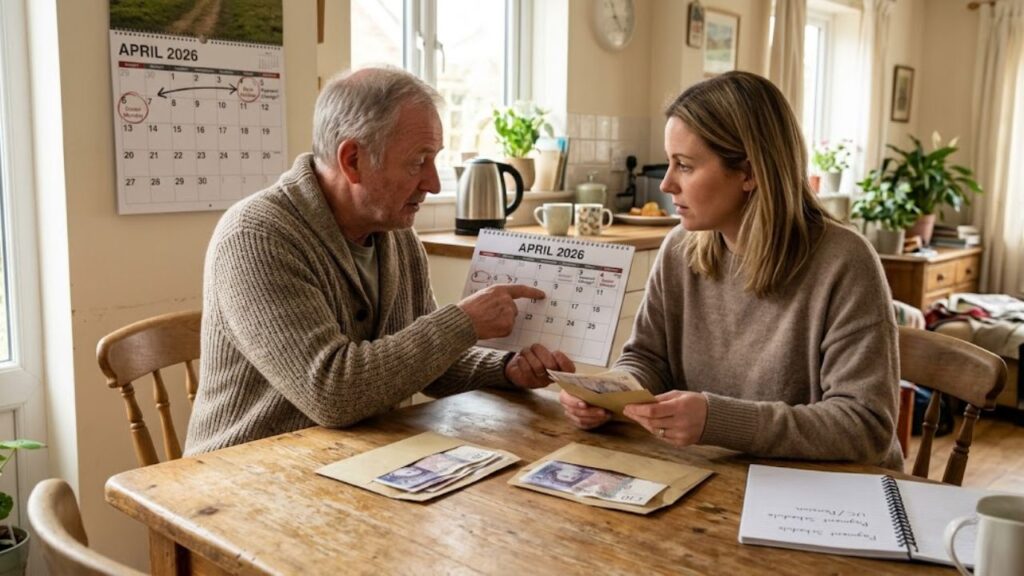
Benefit payments will go out as usual in April except on two key dates. Anyone due a benefit payment on Friday 3 April or Monday 6 April should instead receive this on Thursday 2 April.
This includes
- universal credit
- state pension
- pension credit
- child benefit
- disability living allowance
- personal independence payment,
- attendance allowance
- carer’s allowance.
The DWP is aiming to complete the migration of all legacy benefits to universal credit by the end of March 2026. Those receiving tax credits, income support jobseeker’s allowance and housing benefit should have received a notice about moving to universal credit already.
Pension payment dates in April
The basic state pension is paid straight into bank accounts similar to how benefits are paid. It is usually paid every four weeks with the exact day you receive it corresponding to the last two digits of your national insurance number.
Here’s when you should be paid based on those numbers.
- 00 to 19 on Monday,
- 20 to 39 on Tuesday,
- 40 to 59 on Wednesday
- 60 to 79 on Thursday
- 80 to 99 on Friday.
The same bank holiday payment date changes that apply to most benefits will also apply to state pension payments.
When will benefit rates go up
In April 2026 all universal credit claimants will receive an above inflation income boost of around 6.2 per cent to the standard allowance. For a single person over 25 this will be a £6 per week increase rising from £92 to £98.
For couples with one or both partners over 25 it will be an increase of £9 per week rising from £145 to £154.
Most other benefits should be uprated by September’s inflation rate alone increasing by 3.8 per cent.
This includes PIP, DLA, attendance allowance, carer’s allowance ESA and more. However at the same time the monthly payment rate for the health related element of universal credit for new claimants will be cut from £105 to £50. The rate for existing claimants will also be frozen until 2029.
This is a reduction of more than £200 a month cutting the additional rate by around half. This means it is advisable for anyone who thinks they might be eligible to apply as soon as they can. The state pension will rise by 4.8 per cent from next April in line with annual earnings growth. This will bring the weekly amount to £241.05
Crisis and Resilience Fund
From April councils will be able to administer Labour’s new Crisis and Resilience Fund designed to support low-income households at times when affording the essentials becomes a struggle.
 DWP PIP Eligibility List 2026: 178 Medical Conditions Qualifying for Weekly Payments Explained
It will replace both the household support fund and discretionary housing payments.
Crisis payment
The first part of the new scheme will be a crisis payment to support low-income households that have experienced a financial shock or are at risk of entering crisis.
Like the Household Support Fund councils will continue to have discretion over the exact eligibility criteria.
However the government’s guidance says it should not be limited just to those in receipt of benefits. The DWP has asked that councils take a cash-first approach to the crisis payment meaning cash payments should be awarded unless there is a fair reason not to do so. Housing payment A new housing payment will also be introduced across the UK aimed at providing financial support towards housing costs for those in need. This will usually be related to rent such as needing rent in advance or a rental deposit or shortfall. It could also cover a lump sum associated with housing like the cost of moving.
Unlike the crisis payment the housing payment will be restricted to those in receipt of certain benefits. These are either housing benefit or universal credit with the housing element for rental costs. However DWP says those who do not qualify but are still in need could be considered for a crisis payment instead.
Budgeting advance loans
The government offers a budgeting advance loan for people on universal credit who face an emergency lack of money.
The loan has a maximum repayment period of two years. These loans are interest-free and are automatically deducted from universal credit payments.
You can borrow an advance of up to £348 if you’re single
- £464 if you’re part of a couple
- £812 if you or your partner claims child benefit.
Following Labour’s 2024 Budget a new cap was introduced on the amount the DWP can deduct from benefit payments to repay loans and debts including budgeting advance loans.
Beginning in April 2025 deductions from universal credit have been capped at 15 per cent of the standard allowance down from 25 per cent.
Charitable grants
If you are struggling financially you may be eligible for certain charitable grants. There is a wide range of grants available depending on your circumstances.
However these grants will typically require you to meet specific criteria and will only be able to offer limited funds.
Charitable grants are available for people who are disabled or ill or carers or bereaved or unemployed or students and for many other reasons. The charity Turn2us has an online tool to search for grants which may be available to some.
Social tariffs for broadband and water
For those struggling with household costs social tariffs are available for both broadband and water bills. This will mean a reduced rate for certain eligible households. For water every company operating in the UK has a social tariff by law. However the amount on offer can vary between regions and because water providers can’t be chosen like energy providers the support has been criticised as a postcode lottery.
For instance some offer as much as 90 per cent off bills while others cap support at a 20 per cent reduction. To find out what support your water company offers it is worth checking on its website or contacting the helpline. In all cases households will need to be deemed to be on a low income or in receipt of certain benefits. Similarly many broadband providers offer social tariffs to those on certain benefits like universal credit or pension credit.
Council tax reduction
If you meet certain criteria or are on certain benefits you may be able to apply for a discount on your council tax of up to 100 per cent (this is sometimes called council tax support). Your local council may still be able to offer you a discretionary reduction if you can demonstrate you are facing severe hardship & can’t afford to pay your council tax. To apply for a council tax reduction contact your local council via the government’s website.
Up to 30 hours of free childcare
From 1 September 2025 all working parents in the UK became entitled to 30 hours of free childcare for childrenup to the age of four. This was the final stage of a series of expansions that started in April 2024. Parents need to apply online & confirm their eligibility every three months before each school term begins. Working parents can also apply for tax-free childcare which returns 20p for every 80p spent on childcare up to a maximum of £500 per year.
Energy price cap
Is it going up? The Ofgem energy price cap will fall to £1,641 for the period from 1 April to 31 June 2026. This represents a decrease of about seven per cent or £117. Until 31 March it will stay at £1,758.
The energy price cap sets the maximum amount energy suppliers can charge for each unit of energy if you have a standard variable tariff. Most households are on this type of tariff. The cap is shown as an annual bill for an average home. Many experts including Ofgem are suggesting that households look at fixed tariff energy deals. Many of these deals currently offer rates lower than the price cap. Ofgem will announce the cap for July to September by 27 May. Energy consultancy Cornwall Insight has warned this could rise steeply by as much as 10 per cent or £160 because of the situation in the Middle East.
Will there be another cost of living payment in 2026?
The DWP has not announced any plans to continue the cost of living payment scheme that operated between 2022 & 2024. The final payment was made to eligible households between 6 February & 22 February 2024.